Looking back on the books that we have read for our group i have this to say; some of the books seem very modern. I am referring to Tarzan Of The Apes and Of Mice and Men. Both are easier reads so that's why i think these seem to have been the easiest to understand. Other books in this time frame that i disliked mainly because they seem out of date. As I Lay Dying almost makes me think the guy was drugs when he wrote the book adding in weird stuff (like the abortion part which were very uncommon in that time frame). The part about when of the sons comparing the dead fish to his mother just simply creeps me out and the stream of conscious writing style is simply hard to understand.
All of the books have been made into films some have many versions such as Tarzan where the latest movie released about it was by Disney in 1999. The majority of the books have also been turned into theatre productions as well.
Overall i did not like this era of literature, the majority of the stories tend to about country life as opposed to taking place in the city. Some of these books i may read again but the majority no as they are out of my time frame for me to fully understand maybe if I had lived in that time frame i could fully understand.
Side note: i do not take any credit for the map below, it is neat if you can work it but its hard to understand/operate
Friday, January 8, 2010

Thursday, January 7, 2010
Randomhouse's top 100 novels of the 20th century
100 Best Novels picked by thier board
ULYSSES by James Joyce
THE GREAT GATSBY by F. Scott Fitzgerald A PORTRAIT OF THE ARTIST AS A YOUNG MAN by James Joyce
LOLITA by Vladimir Nabokov
BRAVE NEW WORLD by Aldous Huxley
THE SOUND AND THE FURY by William Faulkner (also did As I Lay Dying)
CATCH-22
DARKNESS AT NOON by Arthur Koestler
SONS AND LOVERS by D.H. Lawrence
THE GRAPES OF WRATH by John Steinbeck
UNDER THE VOLCANO by Malcolm Lowry
THE WAY OF ALL FLESH by Samuel Butler
1984 by George Orwell
I, CLAUDIUS by Robert Graves
TO THE LIGHTHOUSE by Virginia Woolf
AN AMERICAN TRAGEDY by Theodore Dreiser
THE HEART IS A LONELY HUNTER by Carson McCullers
SLAUGHTERHOUSE-FIVE by Kurt Vonnegut
INVISIBLE MAN by Ralph Ellison
NATIVE SON by Richard Wright
HENDERSON THE RAIN KING by Saul Bellow
APPOINTMENT IN SAMARRA by John O'Hara
U.S.A. (trilogy) by John Dos Passos
WINESBURG, OHIO by Sherwood Anderson
A PASSAGE TO INDIA by E.M. Forster
THE WINGS OF THE DOVE by Henry James
THE AMBASSADORS by Henry James
TENDER IS THE NIGHT by F. Scott Fitzgerald
THE STUDS LONIGAN TRILOGY by James T. Farrell
THE GOOD SOLDIER by Ford Madox Ford
ANIMAL FARM by George Orwell
THE GOLDEN BOWL by Henry James
SISTER CARRIE by Theodore Dreiser
A HANDFUL OF DUST by Evelyn Waugh
AS I LAY DYING by William Faulkner
ALL THE KING'S MEN by Robert Penn Warren
THE BRIDGE OF SAN LUIS REY by Thornton Wilder
HOWARDS END by E.M. Forster
GO TELL IT ON THE MOUNTAIN by James Baldwin
THE HEART OF THE MATTER by Graham Greene
LORD OF THE FLIES by William Golding
DELIVERANCE by James Dickey
A DANCE TO THE MUSIC OF TIME (series) by Anthony Powell
POINT COUNTER POINT by Aldous Huxley
THE SUN ALSO RISES by Ernest Hemingway
THE SECRET AGENT by Joseph Conrad
NOSTROMO by Joseph Conrad
THE RAINBOW by D.H. Lawrence
WOMEN IN LOVE by D.H. Lawrence
TROPIC OF CANCER by Henry Miller
THE NAKED AND THE DEAD by Norman Mailer
PORTNOY'S COMPLAINT by Philip Roth
PALE FIRE by Vladimir Nabokov
LIGHT IN AUGUST by William Faulkner
ON THE ROAD by Jack Kerouac
THE MALTESE FALCON by Dashiell Hammett
PARADE'S END by Ford Madox Ford
THE AGE OF INNOCENCE by Edith Wharton
ZULEIKA DOBSON by Max Beerbohm
THE MOVIEGOER by Walker Percy
DEATH COMES FOR THE ARCHBISHOP by Willa Cather
FROM HERE TO ETERNITY by James Jones
THE WAPSHOT CHRONICLES by John Cheever
THE CATCHER IN THE RYE by J.D. Salinger
A CLOCKWORK ORANGE by Anthony Burgess
OF HUMAN BONDAGE by W. Somerset Maugham
HEART OF DARKNESS by Joseph Conrad
MAIN STREET by Sinclair Lewis
THE HOUSE OF MIRTH by Edith Wharton
THE ALEXANDRIA QUARTET by Lawrence Durell
A HIGH WIND IN JAMAICA by Richard Hughes
A HOUSE FOR MR BISWAS by V.S. Naipaul
THE DAY OF THE LOCUST by Nathanael West
A FAREWELL TO ARMS by Ernest Hemingway
SCOOP by Evelyn Waugh
THE PRIME OF MISS JEAN BRODIE by Muriel Spark
FINNEGANS WAKE by James Joyce
KIM by Rudyard Kipling
A ROOM WITH A VIEW by E.M. Forster
BRIDESHEAD REVISITED by Evelyn Waugh
THE ADVENTURES OF AUGIE MARCH by Saul Bellow
ANGLE OF REPOSE by Wallace Stegner
A BEND IN THE RIVER by V.S. Naipaul
THE DEATH OF THE HEART by Elizabeth Bowen
LORD JIM by Joseph Conrad
RAGTIME by E.L. Doctorow
THE OLD WIVES' TALE by Arnold Bennett
THE CALL OF THE WILD by Jack London
LOVING by Henry Green
MIDNIGHT'S CHILDREN by Salman Rushdie
TOBACCO ROAD by Erskine Caldwell
IRONWEED by William Kennedy
THE MAGUS by John Fowles
WIDE SARGASSO SEA by Jean Rhys
UNDER THE NET by Iris Murdoch
SOPHIE'S CHOICE by William Styron
THE SHELTERING SKY by Paul Bowles
THE POSTMAN ALWAYS RINGS TWICE by James M. Cain
THE GINGER MAN by J.P. Donleavy
THE MAGNIFICENT AMBERSONS by Booth Tarkington
Thought it was worth to point out 3 out of 6 books are in this list
Sons and Lovers - Accolades

In 1999, the Modern Library ranked Sons and Lovers ninth on a list of the 100 best novels in English of the 20th century.
It contains a frequently quoted use of the English dialect word "nesh". The speech of several protagonists is represented in Lawrence's written interpretation of the Nottinghamshire dialect[1], which also features in several of his poems
Quote:
"Sons and Lovers was the first modern portrayal of a phenomenon that later, thanks to Freud, became easily recognizable as the Oedipus complex. Never was a son more indentured to his mother's love and full of hatred for his father than Paul Morel, D.H. Lawrence's young protagonist. Never, that is, except perhaps Lawrence himself. In his 1913 novel he grappled with the discordant loves that haunted him all his life--for his spiritual childhood sweetheart, here called Miriam, and for his mother, whom he transformed into Mrs. Morel. It is, by Lawrence's own account, a book aimed at depicting this woman's grasp: "as her sons grow up she selects them as lovers--first the eldest, then the second. These sons are urged into life by their reciprocal love of their mother--urged on and on. But when they come to manhood, they can't love, because their mother is the strongest power in their lives."
The Great Gatsby - enough films?
The Great Gatsby has been filmed four times:
The Great Gatsby, in 1926 by Herbert Brenon – a silent movie of a stage adaptation, starring Warner Baxter, Lois Wilson, and William Powell. It is a famous example of a lost film. Reviews suggest that it may have been the most faithful adaptation of the novel, but a trailer of the film at National Archives is all that is known to exist
The Great Gatsby, in 1949 by Elliott Nugent – starring Alan Ladd, Betty Field, and Shelley Winters; for copyright reasons, this film is not readily available;
The Great Gatsby, in 1974, by Jack Clayton – the most famous screen version, starring Robert Redford in the title role with Mia Farrow as Daisy Buchanan and Sam Waterston as Nick Carraway, with a script by Francis Ford Coppola;
The Great Gatsby, in 2000 by Robert Markowitz – a made-for-TV movie starring Toby Stephens, Paul Rudd and Mira Sorvino.
Tropic Of Cancer
The book Tropic of Cancer had a very Critical reception as the large amounts of sexuality in the book was just unheard of at the time. Yet to many literature people it was great piece of work. Here are some opinions of the novel
George Orwell called this novel
"the most important book of the mid-1930s [and Miller is] the only imaginative prose-writer of the slightest value who has appeared among the English-speaking races for some years past.
Samuel Beckett hailed it as "a momentous event in the history of modern writing
Some were not so positive though
Edmund Wilson said of the novel:
The tone of the book is undoubtedly low; The Tropic of Cancer, in fact, from the point of view both of its happening and of the language in which they are conveyed, is the lowest book of any real literary merit that I have ever remember to have read... there is a strange amenity of temper and style which bathes the whole composition even when it is disgusting or tiresome.
In his dissent from the majority holding that the book was not obscene, Pennsylvania Supreme Court Justice Michael Musmanno wrote Cancer is "not a book. It is a cesspool, an open sewer, a pit of putrefaction, a slimy gathering of all that is rotten in the debris of human depravity
Thursday, November 12, 2009
Tarzan of The Apes - Films based on the book

The book Tarzan of the Apes has been made into a number of movies (according to the Internet Movie Database there has been 89 movies with Tarzan in it's title from 1918 to 2008. Originally the first adaptions of the book to film were through silent films which appeared a few years after the book was pubslihed/the character was made. After talking pictures were introduced a popular Tarzan movie franchise was developed, anchored at first by actor Johnny Weissmüller in the title role, which lasted from the 1930s through the 1960s. After the many smaller films Disney’s came out with the animated Tarzan (1999) which marked a new beginning for the ape man, taking its inspiration equally from Burroughs and Greystoke. The newest film does however change the plot a large amount from the original book.
Wednesday, November 4, 2009
The Hobbit -Movie is in the process
The trilogy of Lord of the Rings had great success making lots of money as you can see from the chart below
Rottentomatoes.com provides the following statistics:
The Lord of The Rings: The Fellowship of the Ring:
Box Office: $313,837,577
VHS Rentals: $17,160,000
The Lord of the Rings: The Two Towers:
Box Office: $340,478,898
VHS Rentals: $9,460,000
The Lord of the Rings: The Return of the King:
Box Office: $376,958,965
VHS Rentals: $3,030,000
Taking those statistics for the film we can add them up and find a total:
$1,060,925,440
So after much speculation and rumors it has been confirmed that the prequel to the trilogy is being made.
The Hobbit is going to be a two part film based on the novel The Hobbit (of There and back again) by J. R. R. Tolkien. The film is currently sceduled to be released in December 2011 (Part 1) and December 2012 (Part 2) and will be directed by Guillermo del Toro, with The Lord of the Rings film trilogy director Peter Jackson serving as executive producer and co-writer.
The question is though will The Hobbit have the same success as the its books after it or just by a film for Lord of the Rings nerds to get excited about as they have nothing better to do?
Wednesday, October 28, 2009
Tarzan of the Apes: enough sequels?

Edgar Rice Burroughs wrote the book Tarzan of the Apes, it was first published in 1912 in the pulp magazine All-Story Magazine, the book version was later published in 1914. The book and character was so popular that he wrote almost two dozen sequels later into the 1940's. The question is though how well were these sequels. The majority of the works were written by Edgar himself, some by other authors and a number where they finished off what a piece that Edgar started.
Here is the list of all of the Tarzan books:
Tarzan of the Apes (1912)
The Return of Tarzan (1913)
The Beasts of Tarzan (1914)
The Son of Tarzan (1914)
Tarzan and the Jewels of Opar (1916)
Jungle Tales of Tarzan (1919) (12 short stories)
Tarzan the Untamed (1920)
Tarzan the Terrible (1921)
Tarzan and the Golden Lion (1922/23)
Tarzan and the Ant Men (1924)
Tarzan, Lord of the Jungle (1927/28)
Tarzan and the Lost Empire (1928)
Tarzan at the Earth's Core (1929)
Tarzan the Invincible (1930/31)
Tarzan Triumphant (1931)
Tarzan and the City of Gold (1932)
Tarzan and the Lion Man (1933/34)
Tarzan and the Leopard Men (1935)
Tarzan's Quest (1935/36)
Tarzan and the Forbidden City (1938)
Tarzan the Magnificent (1939)
Tarzan and the Foreign Legion (1947)
Tarzan and the Madman (1964)
Tarzan and the Castaways (1965) (3 short stories)
from the critics point of view the first book Tarzan of the Apes had the most success, but his large number of sequels have had some criticism. Weather it is because none of them can be the original as there is not the lovable story of a child with dead parents who ends up being taken in by a ape who just lost her own child. As she takes and raises the human child as her own, the sequels do not have this element as of course Tarzan is a adult and has had the events of the first book already happen to him. Is this what the others are missing or is that the fact the critics are just simply looking for something too good as they are basing everything off of the original.
Friday, October 23, 2009
The Hobbit or There and Back Again
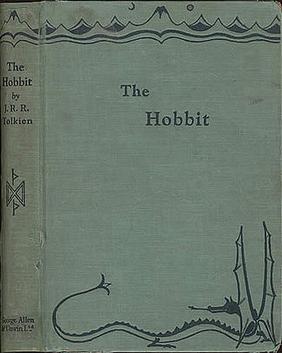
The book i have chosen for my literary essay is The Hobbit by J. R. R. Tolkien the book was published on September 21, 1937. The Hobbit (or There and Back again) is about the journey of the stay at home man Bilbo Baggins. The themes and styles of The Hobbit have helped young readers' literacy skills, preparing them to approach the works of Dickens and Shakespeare. The Hobbit has also been promoted "the original and still the best fantasy ever written". There also been a large number of guides/sparks notes type books published on The Hobbit.
Thursday, October 22, 2009
As I lay Dying the band inspired by the book

The band As I Lay Dying is from San Diego California, formed in 2000 the band consists of vocalist Tim Lambesis, drummer Jordan Mancino, lead guitarist Nick Hipa, rhythm guitarist Phil Sgrosso, and bassist Josh Gilbert, all of whom are Christians and share the Christianity beliefs. The band name came from the book "As I Lay dying" written by William Fualkner Jr. The band four studio albums, one split album (whatever that means) and one compilation album. The band has also been nominated for a Grammy.
Wednesday, October 14, 2009
John Ernst Steinbeck, Jr - Major Works
John Ernst Steinbeck, Jr was a American writer, he wrote the Pulitzer Prize-winning novel The Grapes of Wrath (1939) and the novella Of Mice and Men (1937). He wrote a total of twenty-seven books, including sixteen novels, six non-fiction books and five collections of short stories. In 1962, Steinbeck received the Nobel Prize for Literature. Here are his major works during his writing career
Of Mice and Men
Of Mice and Men is a tragedy that was written originally intended for theater. The story is about two men Lennie and (whose history who know little of besides that Lennie's Aunt died and told George to take care of Lennie as her dying wish). George and Lennie are ranchers who are trying to raise enough money to buy their own farm/ranch.
The Grapes of Wrath
The Grapes of Wrath was written in 1939 and won the Pulitzer Prize in 1940. The book was set in the Great Depression and describes a family of sharecroppers, the Joads, who were forced to leave their land due to the dust storms of the Dust Bowl. The book was made into a major motion picture in 1940 starring Henry Fonda and directed by John Ford.
East of Eden
Steinbeck deals with the nature of good and evil in this Salinas Valley saga. The story follows two families: the Hamiltons - based on Steinbeck's own maternal ancestry - and the Trasks, reprising stories about the Biblical Adam and his progeny. The book was published in 1952.
Thursday, October 8, 2009
Lennie
Here is the final scene Of Mice and Men where George decides Lennie's fate and kills him. After realizing he is doomed to a life of loneliness and despair like the rest of the migrant workers and wanting to spare Lennie a painful death at the hands of the vengeful and violent Curley, shoots Lennie in the back of the head before the mob can find him after they had recited their dreams of owning their own land so Lennie dies thinking happy.
Wednesday, October 7, 2009
Of Mice and Men in Pop Culture
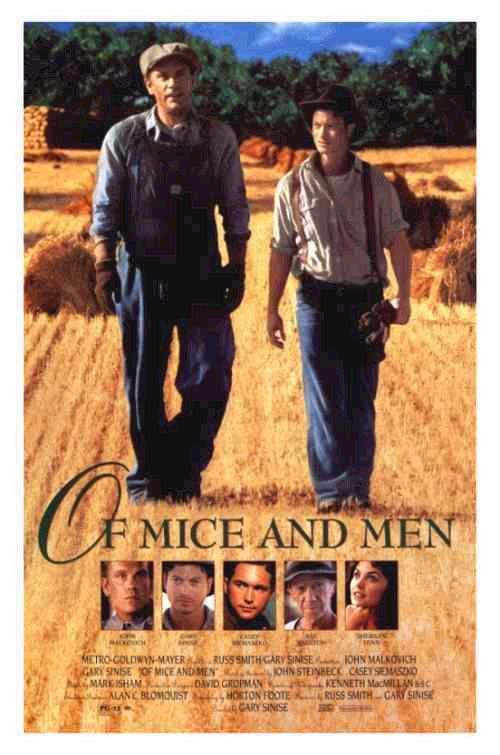
Of Mice and Men is a novel written by Nobel prize winner John Steinbeck, it was published in 1937 and has been adapted to film and other media outlets numerous times. The first time is was turned into a film was two years after the book was originally published in 1939 with great success nominated for four Oscars. In 1981 it was made into a TV movie and did not receive the same amount of success as the previous adapted version. The book was also made into a theater production in November of 1937 it ran for 207 performances it was chosen as Best Play in 1938 by the New York Drama Critics' Circle. In 1939 the production was moved to Los Angeles. The play was later revived in a 1974 Broadway production in the Brooks Atkinson Theater. The book Of Mice and Men had a large part in pop culture here are some examples
In Futurama the episode Love and Rocket Bender plays with the ship's control panel. The ship then says: "Stop it! You're mussing up my trajectory!" Like Curley's Wife in the novel.
Theatrical cartoon shorts of the 1940s and 1950s, particularly the Looney Tunes and Merrie Melodies cartoons released by Warner Bros., are particularly awash with Of Mice and Men parodies. The Of Mice and Men reference most often in the form of one character asking another, à la, Lennie, "which way did he go, George; which way did he go?"
Tex Avery, who worked as a director on Warner-released cartoons during the 1930s and early 1940s, started the trend with Of Fox and Hounds (1940). The formula was so successful that it was utilized again and again in subsequent shorts
In the King of the Hill episode "Of Mice and Little Green Men," Bobby and Hank act in a stage production of Of Mice and Men. Also, in the episode "serPUNt," Bobby's pet snake goes down a sewer causing a panic. The snake is killed, but Hank tells his son Bobby that they let it loose on a farm. At the end of the episode, Bobby asks Hank to "tell me about the farm," in the same manner that Lennie asked George.
The animated series American Dad! has an episode "Of Ice and Men".
In the SpongeBob episode, "Sleepy Time," a book is briefly shown labeled Of Snails and Men.
In The Weekenders, the popular cartoon series, Carver makes a reference to Of Mice and Men when he is trying to get over his fear of going on air for a radio show.
In the Stephen King serial novel The Green Mile, John Coffey (played by Michael Clarke Duncan in the 1999 film) is similar to Lennie in that he is large, unintelligent, and innocent at heart. In both stories, mice fall into their care at some point.
In the popular webcomic Penny Arcade there is a strip entitled; "Of Dice and Men".
In Ian Fleming's first James Bond novel, Casino Royale, one of Le Chiffre's two guards is described as "rather like Lennie from Of Mice and Men"
Tuesday, September 22, 2009
Stream of Conscioucness - Literary Techniques

During the period of literature i am studying for English one of the more common styles used for writing at this time was Stream of Consciousness. The definition is; In literary criticism, stream of consciousness is a narrative mode that seeks to portray an individuals point of view by giving the written equivalent of the character's thought processes, either in a loose interior monologue, or in connection to his or her actions. From what i have read so far in As I Lay Dying the story is described through the random thoughts of the person narrating. It is hard to follow as there are many leaps in syntax and punctuation that makes the book seem unfinished or that it skips parts. Instead of a character narrtarouing the actions of the plot of the book they describe through fragmentary and some feelings. In Stream of consciousness, the speaker's thought processes are more overheard in the mind and is primarily a fictional device. As well it makes for a hard read as you often drift off in the character's thought process yourself.
Wednesday, September 16, 2009
As I Lay Dying - Just Starting

So i have just started to read As I Lay Dying by William Faulkner who i talked about in my previous post. So i have gotten some more background information on the book itself this time. First of all the book was written in six weeks while William Faulkner was working at a power plant at the time he wrote the book. The book was published in 1930 and has been described by Faulkner himself as a "tour de force". The title of the book comes from Book XI of Homer's The Odyssey from the quote "As I lay dying, the woman with the dog's eyes would not close my eyes as I descended into Hades". The novel is known for its stream of consciousness writing technique, multiple narrators (15 for some reason) and varying chapter lengths. One chapter only has five words during how this makes sense i have no clue. The book is done through a stream of consciousness (a narrative mode that seeks to portray an individuals point of view by giving the written equivalent of the character's thought processes). In other words i think this means the story is told through other character's point of view as opposed to through the actions of the main character. I think this could be interesting way to write a story but depending on the plot it could just drag out the story too.
As I Lay Dying has been consistently ranked among the best novels of the 20th century, the novel has been reprinted by the Modern Library, the Library of America and many other publishers. The novel has also influenced a number of other critically acclaimed books including Graham Swift's Last Orders. Also Grammy-nominated metal core band As I Lay Dying derived its name from the novel.
Tuesday, September 15, 2009
William Faulkner - Background information

The first book i going to be reading as part of my study on literature during the 20th century before WW2 starts with As I Lay Dying by William Faulkner.
So i did some research on the author to start, William Faulkner(September 25, 1987 - July 6, 1962) was a Nobel Prize winning American author. He was considered one of the most influential writers of the 20th century. He got this reputation by his work on his novels and short stories. He also published poems from time to time and was an occasional screenwriter. William got his work published starting in the 1920s but was a unknown name until he received the Nobel Prize in Literature in 1949. During his writing career he published 13 novels and numerous short stories. His most celebrated novels such as The Sound and the Fury (1929), As I Lay Dying (1930), Light in August (1932) and Absalom, Absalom! (1936).Most of his short stories are set in Yoknapatawpha County (fictional county created by William himself)which is based upon his hometown of Oxford, Mississippi. Through his achievements he has often been credited as one of the most important writers in the history of American Literature.
So from what i have read about the author i going to assume As I Lay Dying most likely will take place in a small town in the middle of no where in the Mid - Western states, and something or someone upsets the small town and chaos (from a redneck point of view) ensues
Subscribe to:
Posts (Atom)
